
OpenAI publica la guía de prompts de GPT 5.5: 7 cambios clave
When GPT-5.5 launched, OpenAI published an official prompting guide. If you still write step-by-step “micromanagement” prompts from older models, you may be narrowing what the model can do. This article turns the seven most important shifts into practical guidance.
Keywords: chatgpt, gpt 5.5, gpt tutorial.
Published: May 22, 2026
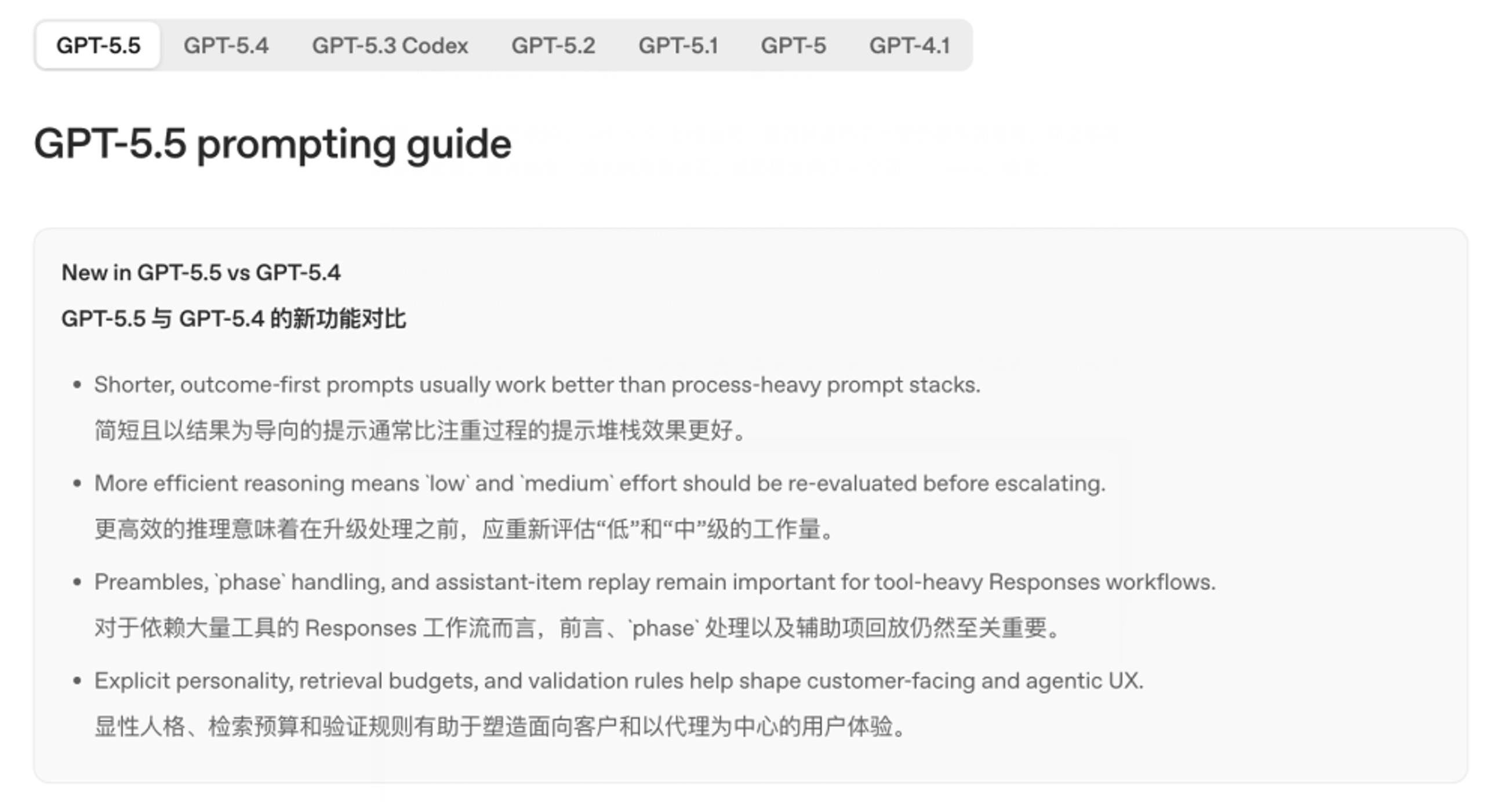
Background: why legacy prompts need a rewrite
Django co-creator Simon Willison noted that OpenAI recommends rewriting from scratch rather than assuming tuned legacy prompts still work. If you are moving to GPT-5.5 (or trying similar capabilities on LimaxAI), treat prompts as a new product design—not a model-name swap.
Change 1: from hand-holding to outcome-first
Estilo antiguo (proceso primero):
Comprueba A, luego B, compara campos uno a uno, razona cada excepción, decide qué herramienta llamar y explica todo el proceso al usuario.
Estilo nuevo (resultado primero):
Resuelve por completo el problema del usuario. Usa política y datos de cuenta para decidir qué hacer primero; informa qué se hizo y qué queda. Si falta información, haz solo la pregunta más crítica.
Describe el destino, no cada giro del mapa. GPT-5.5 planifica su propio camino; un guion rígido puede bloquear mejores rutas.
Change 2: fewer absolutes—reserve them for real red lines
Guardrails like “always JSON,” “never exceed 500 words,” or “must search before answering” were common. GPT-5.5 is highly sensitive to absolutes—when two conflicting “must” rules appear, the model may try to satisfy both and fail both.
| Situation | Recommended style |
|---|---|
| Safety rules, required fields, hard bans | Use always/never |
| Whether to search or ask the user | Use conditional rules |
Example: replace “must search before answering” with “After receiving the question, check whether existing context is enough to answer; if yes, reply directly without searching.”
Change 3: roles return—but stay short
- Steady: reliable collaborator—calm, direct; advance without unnecessary check-ins.
- Expressive: conversational, curious; ask when ambiguous, decide when context is enough.
Change 4: acknowledge multi-step work before executing
Products like Codex already use this pattern (e.g. “Analyzing your codebase, starting with test files”) for APIs and long ChatGPT tasks alike.
Change 5: define stop conditions
Si solo dices «busca información relevante y responde» sin definir cuándo parar, el modelo puede entrar en bucles de recuperación.
Dos estrategias habituales:
- Presupuesto de búsqueda: una ronda por defecto en Q&A normal; responde si la evidencia de la primera página basta. Segunda ronda solo si la primera no tiene la respuesta, faltan datos clave o el usuario pide cobertura exhaustiva.
- Parada de bucle: tras cada ronda de herramientas, pregúntate si la evidencia actual responde la pregunta central; si sí, para.
Change 6: the official seven-part prompt skeleton
| Section | Purpose |
|---|---|
| Role | 1–2 sentences: function and context |
| Personality | Tone, style, collaboration |
| Goal | User-visible deliverable |
| Success | Definition of done |
| Constraints | Safety, business, evidence, side effects |
| Output | Format, length, voice |
| Stop rules | When to retry, escalate, refuse, ask, or stop |
OpenAI developer console also offers Optimize to reshape prompts to this structure.
Change 7: format control and concise defaults
GPT-5.5 responde de forma concisa y directa por defecto. En la API usa text.verbosity (medium por defecto; prueba low para respuestas más cortas); para formatos complejos prioriza Structured Outputs.
Ejemplo:
Por defecto párrafos naturales; títulos, negrita y listas solo cuando ayuden a comprender.
En reescrituras, indica qué conservar antes de cómo editar:
Conserva estructura, longitud y voz originales; mejora solo la claridad—sin nuevas afirmaciones o párrafos salvo petición del usuario.
Sin reglas de conservación, el modelo suele expandir y reestructurar por defecto.
Migration tip: tune reasoning effort from the low end
Beyond prompts, re-evaluate reasoning.effort. GPT-5.5 defaults to medium; many tasks work at low. Higher is not automatically better—conflicting instructions or weak stop rules plus high effort can mean over-searching and detours. Run A/B tests on a fixed eval set; start with low / medium, then move to high / xhigh only when quality gains justify latency and cost.
Summary: one line to remember
Say what you want—not how to do every step.
| Dimension | GPT-5.4 and earlier | GPT-5.5 |
|---|---|---|
| Process | Detailed steps | Outcomes only |
| Tone | Many absolutes | Absolutes for red lines; conditionals elsewhere |
| Role | Long background | 1–2 sentences + personality |
| Multi-step | Execute immediately | Preamble first |
| Stopping | Often omitted | Should be explicit |
| Structure | Free-form | Seven-part skeleton (trim as needed) |
| Format | Defaults | API params + prompt guidance |
After rewriting, run side-by-side tests on real tasks. To try GPT in chat, use the button below on LimaxAI with your preferred model.